
The Rise Of The Idea Of Blue Economy
Green economy is defined as an economy that seeks to achieve long-term development without damaging the environment and is closely related to environmental economics.
During the Rio+20 Summit in June 2012, Pacific small island developing states argued that “a green economy was actually a blue economy” for them.
Hence, the blue economy is a subset of the green economy.
The Need For Blue Economy
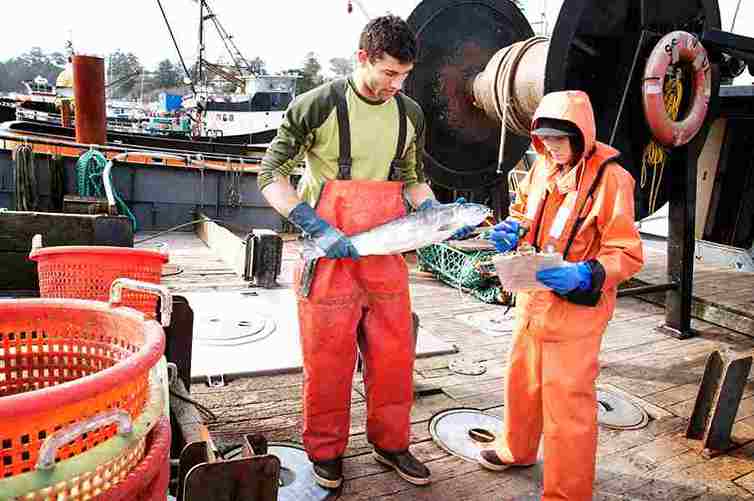
About 40% of the world’s population lives near the coasts, more than 3 billion people rely on the oceans for a livelihood, and the seas account for 80% of global trade. The oceans, seas, and coastal areas support food security and poverty alleviation. Nonetheless, human activities pose a serious threat to the oceans, with economic growth rising at the expense of environmental damage. The impacts on marine ecosystems include acidification, pollution, ocean warming, eutrophication, and fishery collapse, to name a few. These risks are harmful to the planet and have long-term consequences, necessitating immediate action to protect the oceans and the people who rely on them.
Goal 14 of the SDGs stated Life Below Water, talks about the conservation and sustainable use of the oceans, seas and marine resources for sustainable development, and demands international cooperation for the oceans to get back in balance. And, the UN has mentioned that Blue Economy is Goal 14 put to practice.
What Is Blue Economy
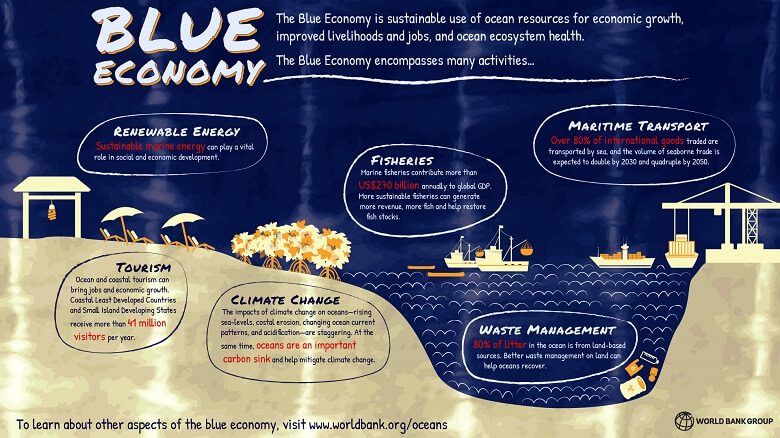
The UN defines a blue economy as “an economy that comprises a range of economic sectors and related policies that together determine whether the use of ocean resources is sustainable.” In simple words, it is the sustainable use of oceanic resources for economic growth and improved livelihoods while maintaining the health of the marine ecosystem. It includes all activities related to oceans, seas and coasts, and covers a wide range of interlinked sectors such as aquaculture, fisheries, maritime transport, mineral resources, carbon sequestrations and several more. It is an emerging field with an emphasis on efficient management. Blue justice (an approach to understanding the impact of unsustainability on coastal communities and small-scale fishing) and blue growth (support for growth in the maritime sector in a sustainable manner) are integral to the blue economy.
Significance Of Blue Economy
The Blue Economy has the potential to improve marine ecosystem governance, reduce emissions, create a more equitable health standard, and contribute in combating climate change. Emerging energy sectors have risen dramatically in recent years, and oceans are significant locations for renewable energy. Wind energy, hydropower, and tidal energy are all suited for marine environments. For instance, the growth in offshore wind energy. Offshore wind (including floating wind turbines) is rapidly expanding and has been present for many years; the first offshore wind park was built in Denmark in 1991, and the number of offshore wind farms is expected to reach 162 by 2020, according to WFO. According to the International Energy Agency’s (IEA) report, Offshore Wind Outlook 2019, offshore wind power has the potential to generate more than 18 times the world’s electricity consumption today.
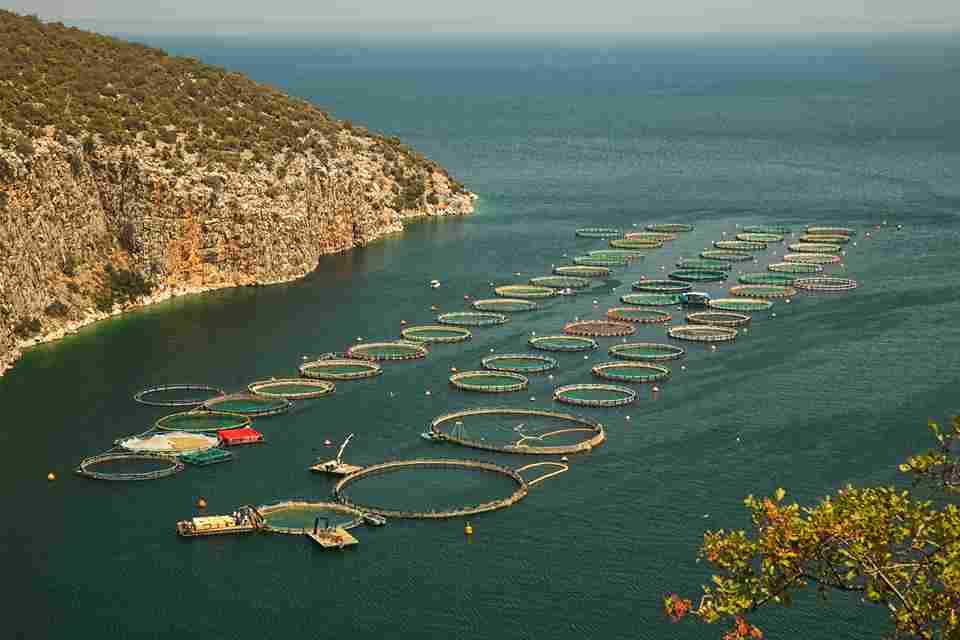
Offshore wind energy is only one example of how the Blue Economy is beneficial. Offshore aquaculture (a new approach to fish farming), wave and tidal energy, seabed mining, and blue biotechnology (which uses shellfish, bacteria, and algae, among other things) are among the others. Furthermore, existing sectors, such as shipping and tourism, have the potential to grow and become more environmentally friendly with technological advances.
Challenges To Blue Economy
Firstly, developing a Blue Economy requires a stable economy and long-term financial strategies, which have become significant obstacles for many countries because of COVID-19. Financial hurdles are a major hindrance to the adoption of the Blue Economy, and developing countries are usually the ones that pay the price. These countries find the shift challenging due to a lack of capacity and technology. Furthermore, governments need a qualified workforce, which demands field training.
Secondly, when promoting a blue economy, the UN emphasises the importance of social equity. Land and resources often belong to communities, and the interests of communities relying on the ocean are frequently disregarded because major sectors such as coastal tourism are seen as more profitable. This means that the Blue Economy must contribute to the achievement of SDG 14 while not undermining other goals of the 2030 Sustainable Development Goals Agenda.
Finally, since the Blue Economy is built on various fields of ocean science, it requires intersectoral expertise and stakeholders. NGO’s, fisherman’s groups, indigenous people, and communities are all crucial components of an inclusive economy. Science and innovation, on the other hand, are required to comprehend the environmental and socioeconomic components of a Blue Economy. As a result, the foundation for developing a Blue Economy can be rigorous and requires a large number of professionals in various sectors, which some countries may not have access to. Developing countries must therefore rely not just on their own national specialists, but also on the expertise of other countries.
Image credit- worldbank.org

Prachi, an accomplished Chief-Editor at The Sustainable Brands Journal, has 15+ years of experience in Europe, the Middle East, and India, managing 90+ global sustainable brands. She’s a prolific writer in sustainability, contributing to various publications. Prachi’s unwavering passion and expertise make her a recognized authority, driving positive change and inspiring a sustainable future.