Plant-Based Economy: Beyond Food into Materials and Sustainable Packaging
When most people hear the term plant-based, they immediately think of food — meat alternatives, dairy-free milk, or vegan diets.
But a much bigger transformation is happening behind the scenes.
The plant-based economy is rapidly expanding far beyond food. Today, plants are becoming the foundation for next-generation materials, textiles, and sustainable packaging solutions that are reshaping industries from fashion to logistics.
From bioplastics made from sugarcane to mushroom-grown packaging materials, companies are exploring innovative ways to replace fossil-fuel-based plastics with renewable alternatives.
This shift is not just driven by ethics or environmental awareness.
It is becoming an economic and regulatory necessity.
As governments tighten restrictions on single-use plastics and consumers increasingly demand transparency from brands, businesses are accelerating investments in plant-based materials and eco packaging innovation.
The implications extend across industries — from packaging and fashion to manufacturing and consumer goods.
Why the Plant-Based Economy Is Growing
The growth of the plant-based materials industry is closely tied to the global sustainability crisis.
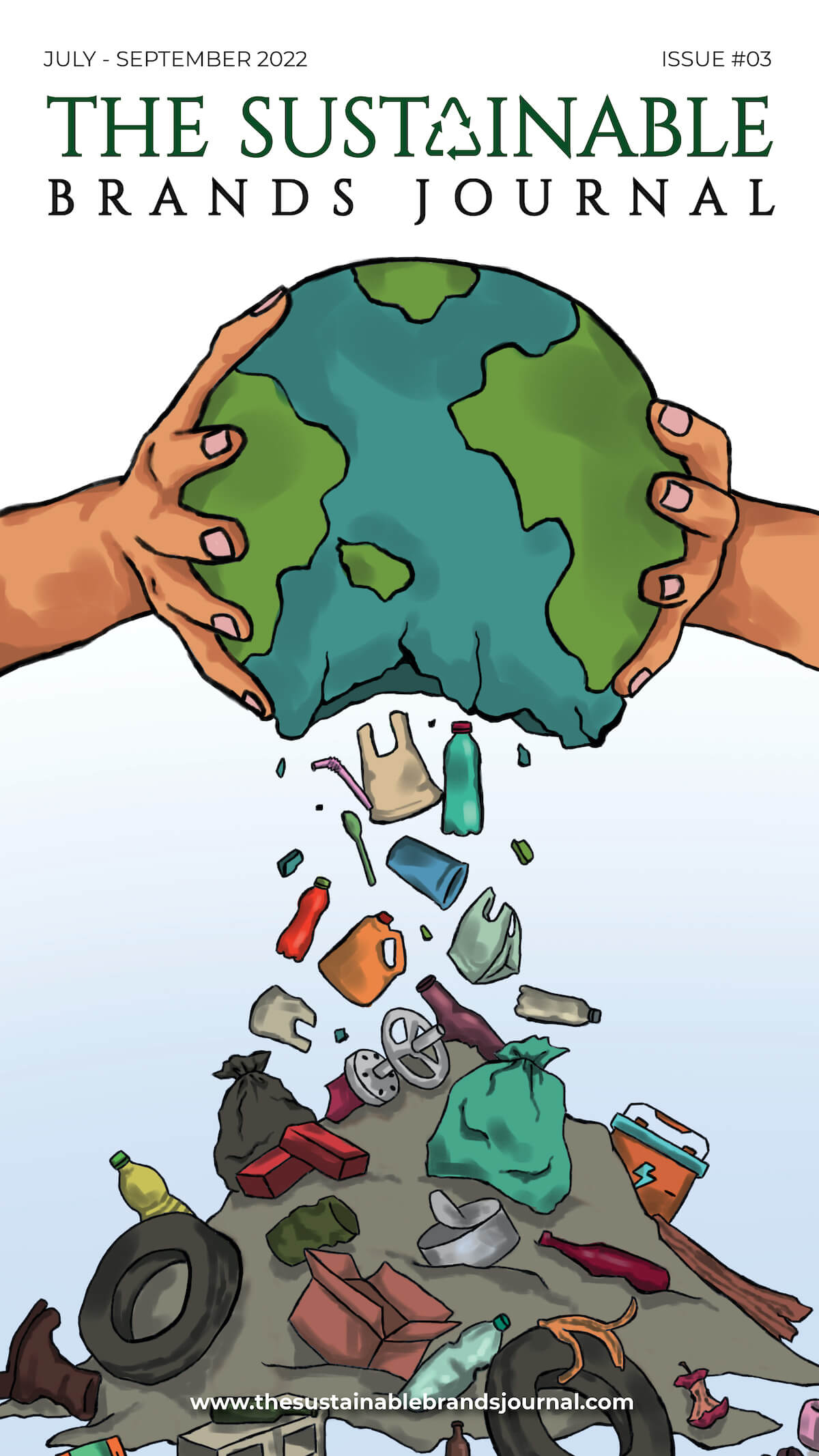
Plastic pollution has become one of the most visible environmental challenges of our time.
Today:
- The packaging industry accounts for nearly 40% of global plastic consumption
- More than 8 million tons of plastic enter the oceans each year
- Many petroleum-based plastics take hundreds of years to decompose
These realities are pushing governments and companies to rethink the materials that power modern economies.
At the same time, consumers are becoming more environmentally conscious and are increasingly adopting sustainable lifestyles. For example, practices such as reducing waste and adopting circular consumption habits — like those outlined in Zero Waste Lifestyle: 7 Practical Steps — are influencing purchasing decisions.
As demand for sustainability grows, businesses are looking for materials that align with both environmental responsibility and economic performance.
The Rise of Plant-Based Materials
Plant-based materials are produced from renewable biological resources rather than fossil fuels.
Common sources include:
- corn starch
- sugarcane
- bamboo
- hemp
- seaweed
- agricultural waste
- plant fibers
Unlike conventional plastics derived from petroleum, many plant-based materials are biodegradable, compostable, or significantly lower in carbon footprint.
For instance, bioplastics produced from sugarcane ethanol can reduce greenhouse gas emissions by up to 70% compared to conventional plastic production.
Another breakthrough material is mycelium packaging, which is grown from the root structure of mushrooms.
Mycelium packaging can replace polystyrene foam (commonly known as Styrofoam) and decomposes naturally in soil within weeks.
These innovations demonstrate how nature-based materials can replace synthetic packaging without sacrificing functionality.
Sustainable Packaging as a Competitive Advantage
One of the fastest-growing segments of the plant-based economy is sustainable packaging.
For decades, plastic packaging dominated global supply chains because it was cheap, lightweight, and durable.
But the environmental costs have become impossible to ignore.
Today, eco-friendly packaging is increasingly influencing purchasing decisions.
Multiple consumer studies show that over 60% of shoppers are willing to pay more for products packaged sustainably.
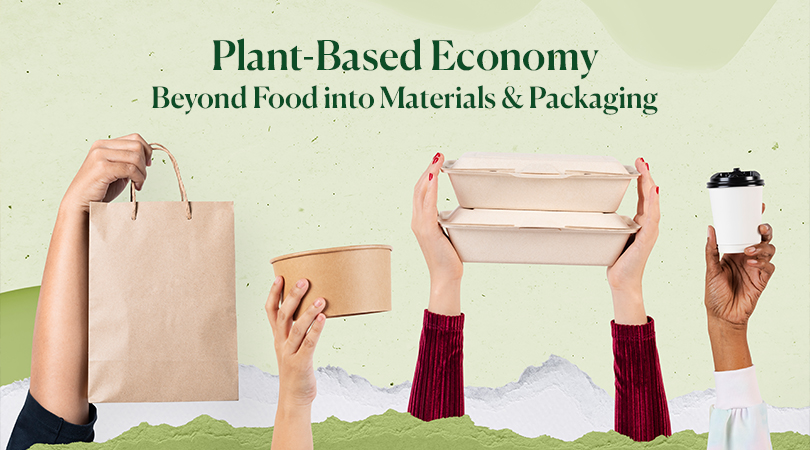
This trend has pushed companies to experiment with new plant-based packaging solutions, including:
- compostable mailers made from plant polymers
- molded fiber trays made from agricultural residue
- algae-based packaging films
- biodegradable food containers made from sugarcane bagasse
For brands, plant-based packaging offers a powerful dual benefit.
It reduces environmental impact while also signaling innovation, responsibility, and sustainability leadership.
Plant-Based Materials and the Circular Economy
The rise of the plant-based economy is closely connected to the principles of the circular economy.
Traditional production systems follow a linear model: extract resources, manufacture products, and dispose of waste.
Circular systems aim to redesign this process so materials remain in use for longer and waste is minimized.
Plant-based materials help support this model because they can be produced using agricultural by-products that would otherwise be discarded.
Examples include:
- sugarcane bagasse used for biodegradable food containers
- wheat straw turned into packaging materials
- fruit waste transformed into plant-based leather alternatives
This approach creates a regenerative supply chain that benefits both the environment and rural economies.
Plant-Based Innovation in Fashion and Manufacturing
Beyond packaging, plant-based materials are transforming fashion and manufacturing industries.
The fashion sector has long relied on animal leather and synthetic materials derived from fossil fuels.
Now, innovative alternatives are emerging, including:
- Piñatex, made from pineapple leaf fibers
- cactus leather, derived from cactus plants
- apple leather, produced from apple processing waste
- hemp and bamboo textiles
These materials provide durable alternatives while significantly reducing environmental impact.
Automotive companies are also experimenting with bio-based interior materials, replacing synthetic plastics with plant fiber composites.
This demonstrates how the plant-based economy extends across multiple industries, not just food and packaging.
Environmental Impact and Ecosystem Protection
Reducing plastic pollution and fossil-fuel dependence also has important implications for global ecosystems.
Large natural environments such as the Amazon rainforest play a critical role in regulating climate and biodiversity.
Understanding these ecosystems — including the environmental importance discussed in Fascinating Amazon River Facts — highlights why reducing pollution and transitioning to renewable materials is essential.
Plant-based materials offer one pathway toward reducing environmental pressure on these fragile ecosystems.
Challenges in Scaling Plant-Based Materials
Despite their promise, plant-based materials still face several challenges.
One major challenge is infrastructure.
Biodegradable and compostable materials require appropriate composting systems to break down effectively.
Without the right waste management infrastructure, some bio-materials may still end up in landfills.
Another challenge is cost competitiveness.
While prices are gradually declining as production scales, plant-based materials can still be more expensive than traditional plastics in some markets.
Land-use management is another important consideration. Expanding demand for plant-based materials must be balanced with responsible agricultural practices to avoid unintended environmental consequences.
A Systems-Level Transition
The plant-based economy represents more than product substitution.
It signals a deeper transformation in how industries design and manufacture goods.
Instead of extracting finite resources, companies are learning to grow materials from renewable biological systems.
For businesses, investing in plant-based materials is both risk mitigation and opportunity.
Regulations targeting single-use plastics are expanding worldwide, and companies that adopt sustainable materials early position themselves ahead of regulatory changes.
For consumers, these changes may appear subtle — a compostable package, a plant-fiber product, or biodegradable packaging.
But collectively, they represent a fundamental shift in how the global economy produces and consumes materials.
Conclusion: Growing the Materials of the Future
The future of sustainability will not be built solely on reducing environmental harm.
It will be built on redesigning the systems that power our economy.
The plant-based economy offers a compelling vision of that future.
By transforming renewable biological resources into materials, textiles, and packaging, industries can reduce dependence on fossil fuels while building more regenerative supply chains.
Increasingly, the materials that shape modern commerce will not be extracted from the earth.
They will be grown.