
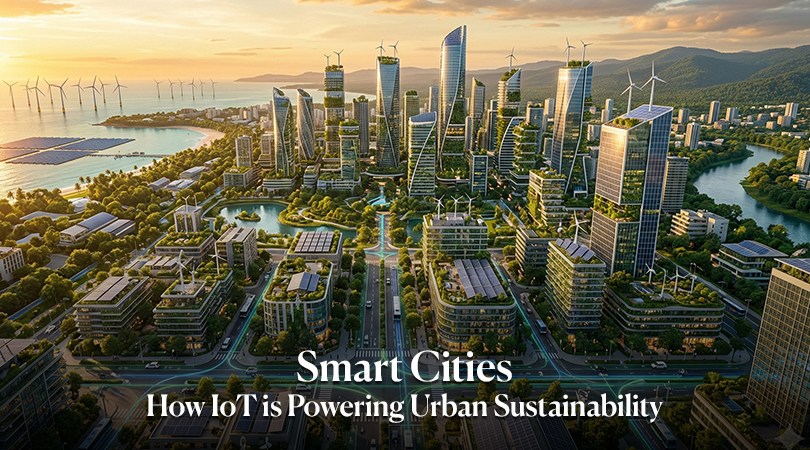
Smart Cities and IoT: How Connected Technology Is Powering Urban Sustainability
By 2050, nearly 70% of the world’s population will live in cities. Urban areas already consume more than 75% of global energy and produce over 70% of carbon emissions, making cities central to the global sustainability challenge.
As populations grow, pressure on infrastructure will increase. Energy systems, transportation networks, water resources, and waste management systems will all face rising demand.
Cities are therefore both part of the problem and a key part of the solution.
This is where smart cities come into the picture.
At the heart of the smart city revolution lies the Internet of Things (IoT) — a network of connected sensors, devices, and digital systems that collect and exchange real-time data. These technologies allow cities to monitor infrastructure, analyze patterns, and optimize how resources are used.
In simple terms, IoT in smart cities gives urban environments the ability to “sense” what is happening and respond intelligently.
The result is a new model of sustainable urban development, where data-driven decision making improves efficiency, reduces emissions, and enhances quality of life.
At the same time, sustainability requires both systemic change and individual action. Many communities are already exploring waste reduction strategies and lifestyle changes such as a zero-waste lifestyle to reduce environmental impact.
What Is a Smart City?
A smart city uses digital technologies such as IoT sensors, data analytics, and connected infrastructure to improve public services, reduce environmental impact, and enhance quality of life for residents.
Unlike traditional cities that rely on fixed infrastructure and manual oversight, smart cities collect real-time data from connected systems embedded across the urban landscape.
These systems may include:
- smart traffic signals
- connected public transport
- smart energy grids
- water monitoring systems
- environmental sensors
By analyzing this data, city governments and urban planners can make more informed decisions about resource management and infrastructure planning.
Leading examples of smart city technology can already be seen in cities like Singapore, Amsterdam, Barcelona, and Copenhagen, where digital systems are helping reduce emissions, improve transportation, and support long-term sustainability goals.
How IoT Powers Smart Cities
The Internet of Things is the technological backbone of smart city infrastructure.
IoT systems consist of connected sensors, communication networks, cloud platforms, and analytics software that continuously gather and process data from urban environments.
These sensors can be embedded in:
- roads and traffic lights
- public transport systems
- energy grids
- water pipelines
- waste collection bins
- air quality monitoring stations
By collecting data across multiple systems, IoT enables cities to optimize operations in real time.
For example:
- Traffic lights adjust automatically to reduce congestion.
- Smart meters track electricity usage in homes.
- Sensors detect water leaks instantly.
- Waste collection routes are optimized based on bin capacity.
Instead of relying on outdated systems and fixed schedules, cities can shift toward predictive and adaptive infrastructure management.
This transformation plays a crucial role in building sustainable and resilient cities.
Smart Energy Systems and Urban Sustainability
Energy consumption is one of the largest sources of urban carbon emissions.
Traditional power grids operate on centralized supply models, where electricity generation is based on estimated demand. This often leads to inefficiencies, energy waste, and difficulty integrating renewable energy sources.
Smart energy grids, powered by IoT technology, allow utilities to monitor energy usage in real time.
These systems help balance electricity supply and demand dynamically, improving efficiency and reducing losses.
A key component of smart energy systems is the smart meter, which provides households and businesses with real-time data about their electricity usage.
Research shows that when consumers can see how much energy they use, they often reduce consumption by 10–15 percent simply through increased awareness.
When applied across an entire city, these behavioral changes can produce significant reductions in carbon emissions.
Smart grids also accelerate the transition toward renewable energy systems, enabling cities to integrate solar and wind power more efficiently.
Intelligent Transportation and Smart Mobility
Urban transportation accounts for roughly 25% of global energy-related CO₂ emissions.
Traffic congestion wastes fuel, increases pollution, and reduces productivity.
Smart cities are using IoT-powered traffic management systems to transform urban mobility.
Sensors, cameras, and AI-powered analytics track traffic flow across the city and automatically adjust traffic signal timing based on congestion levels.
Cities that have implemented adaptive traffic systems have reported:
- 20% reduction in travel time
- 10–15% lower fuel consumption
- significant improvements in urban air quality
Public transportation is also becoming smarter.
Connected buses, trains, and metro systems provide real-time tracking and passenger updates, helping commuters plan journeys more efficiently.
As reliability improves, more people shift from private cars to public transit — an essential step toward reducing emissions and improving urban sustainability.
Smart Water Management
Water scarcity is becoming a growing challenge in many cities worldwide.
Urban water systems often lose large volumes due to leaks, aging infrastructure, and inefficient monitoring.
IoT-enabled water management systems help cities monitor pipelines in real time.
Sensors detect pressure changes or leaks immediately, allowing utilities to repair problems before major water losses occur.
Some cities have reduced non-revenue water losses by up to 25 percent through sensor-based monitoring.
Smart water systems can also track water quality, consumption patterns, and infrastructure performance, allowing cities to conserve resources more effectively.
Smart Waste Management and the Circular Economy
Waste management is another area where IoT technology is improving urban sustainability.
Traditional waste collection often operates on fixed schedules, meaning trucks may collect half-empty bins or miss bins that are already full.
Smart cities are solving this problem with IoT-enabled waste bins equipped with fill-level sensors.
These bins automatically notify waste management services when they are close to capacity.
This enables optimized collection routes, reducing fuel consumption and operational costs.
Smart waste management systems also support broader circular economy strategies, where materials are reused, recycled, or repurposed instead of being sent to landfills.
Cities and communities adopting waste reduction strategies are also encouraging residents to adopt sustainable habits such as zero-waste living.
Environmental Monitoring and Urban Data
One of the most powerful aspects of IoT in smart cities is the ability to collect large-scale environmental data.
Connected sensors can monitor:
- air quality levels
- temperature patterns
- noise pollution
- traffic density
- energy consumption
This data helps city planners identify environmental challenges and implement targeted solutions.
For example, urban heat mapping can reveal neighborhoods experiencing higher temperatures due to dense infrastructure and limited vegetation.
City planners can respond by introducing:
- urban tree planting programs
- reflective roofing materials
- green infrastructure
Environmental monitoring also mirrors how scientists study large natural ecosystems.
For example, understanding environmental systems such as the Amazon River ecosystem helps researchers analyze biodiversity, water cycles, and climate interactions.
Similarly, smart cities use environmental data to better understand and manage their urban ecosystems.
The Human Benefits of Smart Cities
While the technology behind smart cities is complex, the ultimate goal is simple: improving everyday life for people.
When cities become more efficient, the benefits are tangible.
Reduced traffic congestion means less time commuting and more time with family.
Efficient energy systems lower household energy bills.
Cleaner air improves public health outcomes.
Smarter infrastructure also allows cities to respond faster to emergencies and improve public safety.
In essence, smart cities combine environmental sustainability with social and economic progress.
Challenges of Smart Cities
Despite their benefits, smart city technologies also present challenges.
One of the biggest concerns is data privacy and cybersecurity. Since IoT systems collect large volumes of data, cities must ensure this information is stored and managed responsibly.
Another challenge is infrastructure investment. Implementing smart technologies requires significant upfront funding.
There is also the risk of a digital divide, where some communities benefit from smart infrastructure while others are left behind.
Addressing these issues requires strong governance, transparent policies, and inclusive urban planning.
The Future of IoT in Sustainable Cities
The role of IoT in urban sustainability is expected to grow rapidly in the coming decade.
Emerging technologies such as artificial intelligence, digital twins, and advanced data platforms will allow cities to simulate infrastructure changes and predict environmental risks before they occur.
Digital twin technology, for example, can create a virtual replica of a city, enabling planners to test new transportation systems, energy solutions, or climate adaptation strategies.
As climate pressures intensify and urban populations expand, smart city technology will become essential infrastructure rather than optional innovation.
Conclusion: Building Smarter and More Sustainable Cities
Smart cities represent a fundamental shift in how urban environments operate.
Instead of reacting to problems after they occur, cities can use IoT-powered data systems to anticipate challenges and optimize resources.
The Internet of Things is no longer a futuristic concept — it is rapidly becoming essential infrastructure for sustainable urban development.
As urban populations continue to rise and climate challenges intensify, the question is no longer whether cities should become smarter.
The real question is how quickly cities can adopt connected technologies to build a more sustainable future.
A smart city uses digital technologies such as IoT sensors, connected infrastructure, and data analytics to improve urban services, reduce environmental impact, and enhance quality of life for residents.
IoT helps cities collect real-time data from infrastructure such as traffic systems, energy grids, and water networks. This data enables more efficient resource management, reducing energy use, emissions, and waste.
Cities such as Singapore, Barcelona, Amsterdam, and Copenhagen are global leaders in implementing smart city technologies for sustainability.
Cities produce the majority of global carbon emissions. Smart city technologies help reduce emissions by improving energy efficiency, optimizing transportation systems, and enabling better environmental monitoring.