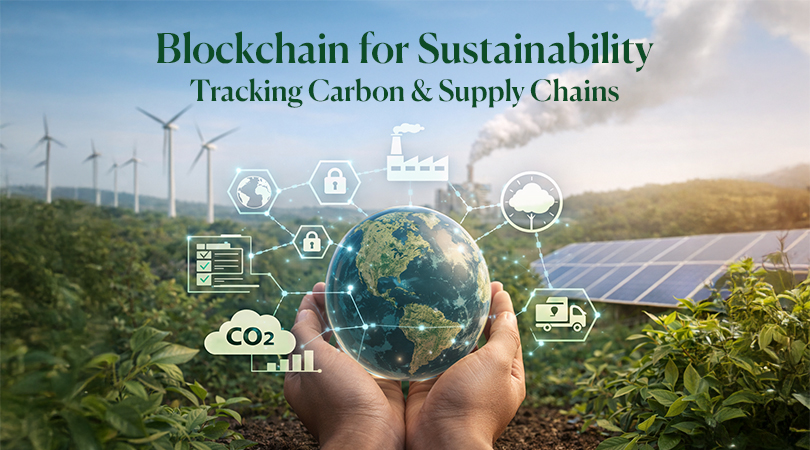
Blockchain for Sustainability: Tracking Carbon & Supply Chains
As climate regulations tighten and consumers demand greater transparency, one question is becoming increasingly important for modern businesses: can sustainability claims truly be verified?
This is where blockchain technology is starting to make a real impact.
While blockchain is widely known for powering cryptocurrencies, its potential goes far beyond digital finance. Businesses are now exploring how blockchain can strengthen environmental accountability, carbon tracking, and supply chain transparency.
At its core, blockchain is a decentralized digital ledger that records transactions securely and permanently. Once information is added to the system, it cannot be altered without network consensus.
For sustainability, this creates something extremely valuable: trust through transparency.
As companies adopt more responsible practices and move toward circular and sustainable business models, digital tools like blockchain are becoming critical for verifying environmental impact.
How Blockchain Enables Carbon Tracking and Emissions Transparency
Measuring carbon emissions across global supply chains is incredibly complex.
A single product’s carbon footprint may involve:
- Raw material extraction
- Manufacturing processes
- International transportation
- Packaging and distribution
Traditional carbon reporting often relies on estimates, manual reporting, or self-declared supplier data. This can lead to data inconsistencies and limited transparency.
Blockchain-enabled carbon tracking systems solve this challenge by creating tamper-proof records of emissions data at every stage of production.
For example, when raw materials are extracted, processed, transported, and manufactured, each step can be logged onto a blockchain ledger. This creates a verifiable carbon trail that regulators, auditors, investors, and even consumers can access.
Such systems significantly reduce the risk of misleading sustainability claims — a growing concern addressed in What Is Greenwashing and How to Avoid It in Your Marketing.
With transparent data, companies can confidently demonstrate progress toward carbon neutrality, emissions reduction, and climate goals.
Blockchain for Sustainable Supply Chain Transparency
Global supply chains are responsible for over 80% of greenhouse gas emissions for many consumer brands. However, most companies still lack visibility beyond their Tier-1 suppliers.
Blockchain technology helps solve this by connecting all stakeholders across the supply chain — including farmers, manufacturers, logistics providers, and retailers — onto a shared digital platform.
Every transaction, shipment, and transfer of goods can be recorded in real time, creating complete traceability from source to shelf.
This has major implications across multiple industries.
Agriculture
Blockchain can verify whether raw materials are sourced from certified sustainable farms.
Fashion
It can track whether textiles were ethically produced and manufactured responsibly.
You can explore sustainable alternatives in A Guide to Finding Eco-Friendly Sustainable Clothing Brands and Top Sustainable Footwear Brands Taking Over India.
Food Systems
Blockchain improves food traceability by confirming product origin and reducing fraud across supply chains.
Beyond environmental tracking, this level of transparency improves operational resilience. Companies can detect disruptions faster, identify inefficiencies, and reduce resource waste across their supply networks.
The Energy Debate Around Blockchain
Despite its benefits, blockchain has also faced criticism for its potential energy consumption.
Early cryptocurrency networks relied on “proof-of-work” validation models, which required large amounts of computing power and electricity.
However, blockchain technology has evolved significantly.
Modern blockchain systems now use energy-efficient consensus mechanisms, such as proof-of-stake, which can reduce electricity consumption by more than 99% compared to earlier models.
In addition, many enterprise blockchain platforms operate on private or permissioned networks, which consume far less energy than public cryptocurrency blockchains.
In this context, blockchain can become a net environmental benefit. The emissions saved through improved tracking, waste reduction, and supply chain efficiency can outweigh the technology’s operational footprint.
These innovations are increasingly being integrated with other sustainability solutions such as renewable energy and green technology, explored further in Renewable Energy Storage: The Future of Green Batteries.
Data as Climate Infrastructure
As global carbon markets expand, accurate emissions measurement and verification are becoming critical.
Blockchain can support carbon credit markets by ensuring that:
- Carbon offsets are not double-counted
- Credits represent real and measurable emission reductions
- Transactions remain transparent and traceable
This is particularly important for voluntary carbon markets, which are expected to grow significantly in the coming decade.
Reliable digital infrastructure will determine whether these markets scale effectively and maintain credibility.
Blockchain technology is therefore emerging as a key digital backbone for climate accountability.
From Transparency to Accountability
Sustainability is evolving.
For years, many companies relied heavily on storytelling and marketing to communicate their environmental commitments. Today, investors, regulators, and consumers are demanding verifiable impact and measurable results.
Blockchain does not reduce emissions directly.
However, it provides the data infrastructure needed to track, verify, and optimize sustainability efforts at scale.
As businesses transition toward resource-efficient and circular production models, discussed in What Is the Circular Economy & Why It’s the Future of Sustainable Business, transparent data systems will become essential.
In the global shift toward a low-carbon economy, transparency is power.
And increasingly, that power is being built into decentralized digital systems designed to make sustainability claims not just visible — but verifiable.
FAQs
Blockchain improves sustainability by creating transparent and tamper-proof records of environmental data. It allows companies to track carbon emissions, verify sustainable sourcing, and improve supply chain accountability.
Yes. Blockchain systems can record emissions data across each stage of a product’s lifecycle, creating a verifiable carbon footprint that regulators and consumers can trust.
Blockchain connects suppliers, manufacturers, and logistics partners on a shared platform. This allows companies to trace products from their origin to the final consumer while verifying sustainability claims.
Earlier blockchain systems consumed high levels of energy, but modern solutions using proof-of-stake and private networks are significantly more energy-efficient.
Transparency builds trust with consumers, investors, and regulators. It ensures sustainability claims are backed by verifiable data rather than marketing promises.