
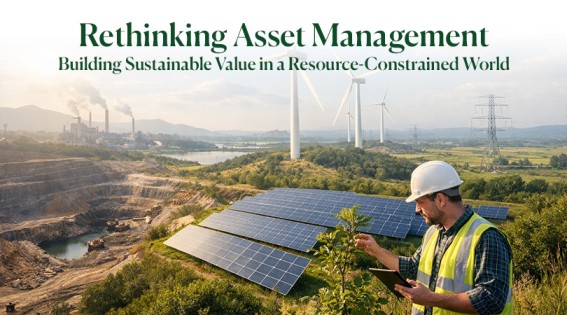
Sustainable Asset Management: Building Sustainable Value in a Resource-Constrained World
In a world facing climate volatility, resource depletion, and regulatory pressure, asset management is undergoing a fundamental shift. It’s no longer just about maximizing returns—it’s about maximizing value without compromising the planet.
Welcome to the era of sustainable asset management, where financial performance and environmental responsibility go hand in hand.
What is Sustainable Asset Management?
Sustainable asset management refers to managing physical and financial assets in a way that:
- Minimizes environmental impact
- Extends asset lifespan
- Aligns with ESG (Environmental, Social, Governance) principles
This includes everything from infrastructure and real estate to industrial equipment and investment portfolios.
The goal is simple:
create long-term value while reducing resource intensity and risk.
Why It Matters Now
Global assets—from buildings to machinery, account for a significant share of environmental impact.
- The built environment alone contributes nearly 40% of global carbon emissions
- Poor asset utilization leads to wasted energy, materials, and capital
At the same time, investors are shifting priorities. ESG-aligned assets are increasingly seen as:
- Lower risk
- More resilient
- Better positioned for future regulations
This makes sustainable asset management not just ethical, but economically strategic.
Key Principles of Sustainable Asset Management
1. Lifecycle Thinking
Instead of focusing only on acquisition costs, organizations are evaluating:
- Total lifecycle cost
- Environmental impact over time
- End-of-life disposal or reuse
This approach encourages durability, repairability, and circular use.
2. Resource Efficiency
Optimizing how assets use:
- Energy
- Water
- Raw materials
Smart systems and monitoring tools can reduce waste and improve performance significantly.
3. Predictive Maintenance
Using data and AI, companies can now:
- Predict equipment failures
- Reduce downtime
- Extend asset lifespan
This reduces unnecessary replacements and lowers environmental impact.
4. Circular Economy Integration
Assets are no longer seen as disposable.
Instead, businesses are adopting:
- Refurbishment and reuse models
- Recycling and material recovery
- Asset-sharing systems
This shifts the model from ownership to optimization.
Technology as an Enabler
Digital tools are accelerating sustainable asset management:
- IoT sensors monitor real-time performance
- AI analytics optimize usage and maintenance
- Digital twins simulate asset efficiency
These technologies help organizations make data-driven, sustainable decisions at scale.
Industries Leading the Shift
Sustainable asset management is gaining traction across:
- Real Estate: Energy-efficient buildings and smart infrastructure
- Manufacturing: Optimized machinery and reduced waste
- Energy: Renewable asset optimization and grid efficiency
- Transportation: Fleet efficiency and electrification
These sectors are proving that sustainability can drive both cost savings and innovation.
Challenges to Address
Despite its benefits, adoption faces barriers:
- High upfront investment
- Lack of standardized ESG metrics
- Resistance to operational change
However, as regulations tighten and technology becomes more accessible, these challenges are gradually diminishing.
Conclusion
Sustainable asset management represents a shift from short-term gains to long-term resilience.
It’s about using fewer resources, generating less waste, and creating assets that perform better over time, for both businesses and the planet.
Because in a resource-constrained world,
The true measure of value is not just what assets generate but how sustainably they do it.

Sourabh is an SEO Specialist associated with The Sustainable Brands Journal, contributing to the platform’s mission of amplifying sustainability-driven narratives. He specializes in content optimization, search strategy, and organic growth within climate, ESG, and eco-conscious industries.