
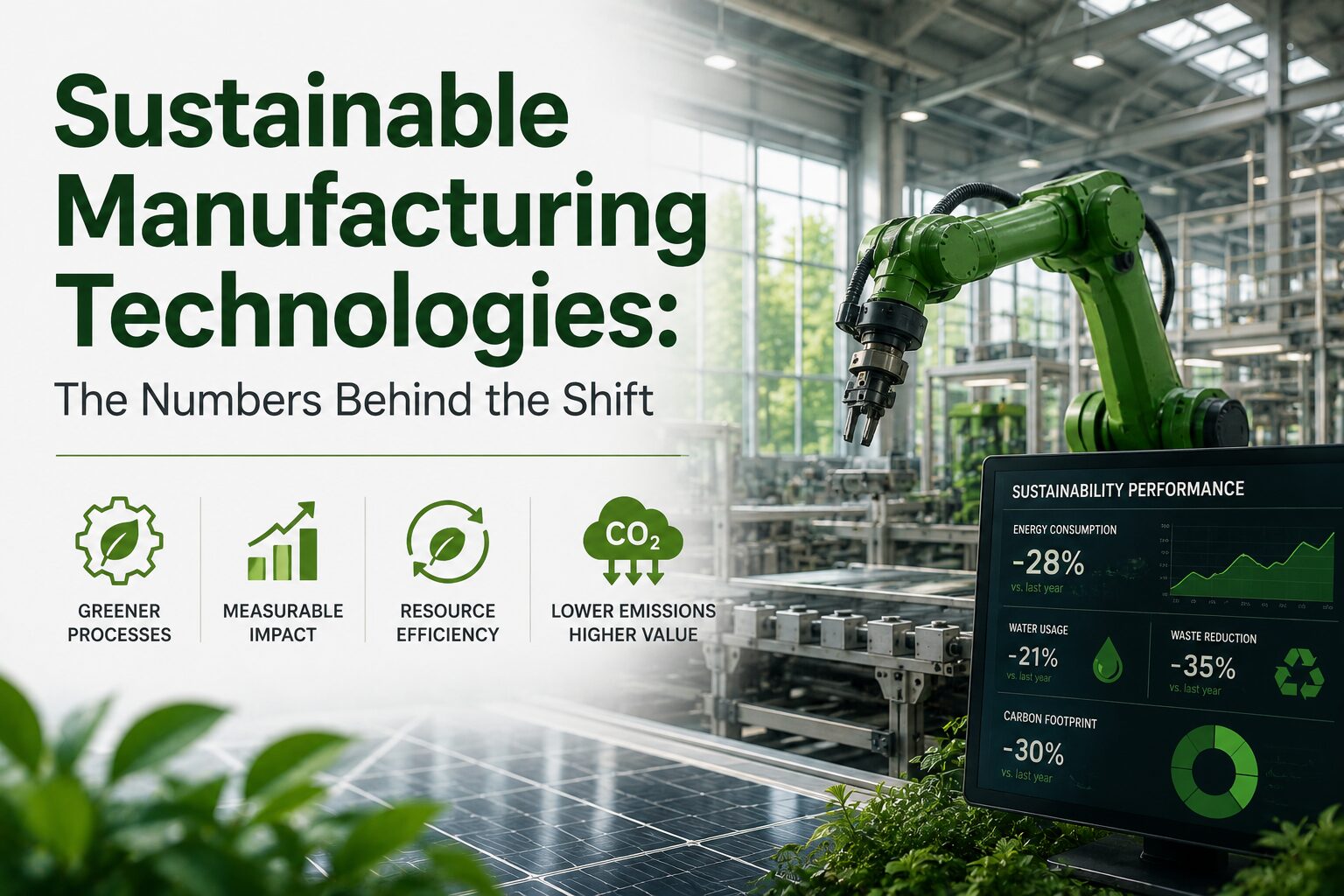
Sustainable Manufacturing Technologies: The Numbers Behind the Shift
Sustainability is no longer a side initiative for manufacturers. It’s becoming a core business strategy that influences everything from production efficiency and operating costs to supply chain resilience and customer trust. As governments tighten environmental regulations and buyers demand greater transparency, manufacturers are investing in technologies that deliver measurable environmental and operational improvements.
The numbers reflect this shift. The global sustainable manufacturing market was valued at approximately USD 231.86 billion in 2025 and is projected to reach USD 601.17 billion by 2034, growing at a compound annual growth rate (CAGR) of 11.1%. At the same time, a 2026 manufacturing leadership survey found that adoption of digital manufacturing platforms increased from 86% of manufacturers in 2024 to 97% in 2026. Nearly three-quarters of respondents now consider sustainability a top operational priority, while 96% report that sustainability directly influences sourcing and procurement decisions.
Behind this transformation are technologies that don’t just promise sustainability—they generate verifiable data that manufacturers, investors, regulators, and customers can measure.
What Are Sustainable Manufacturing Technologies?
Sustainable manufacturing technologies are digital and energy-efficient production systems designed to reduce emissions, material waste, energy consumption, and environmental impact while improving productivity and product quality. Unlike traditional manufacturing upgrades that focus solely on output, these technologies help manufacturers optimize resources, monitor environmental performance in real time, and support long-term ESG and decarbonization goals.
Among the many innovations shaping modern factories, three technologies are delivering the most measurable results in 2026.
1. Digital Twins: Making Manufacturing Smarter and More Efficient
A digital twin is a virtual representation of a physical production line, machine, or manufacturing facility. By continuously collecting data from connected sensors, manufacturers can simulate operations, predict equipment failures, optimize production schedules, and identify opportunities to reduce energy consumption before problems occur.
Today, nearly 48% of manufacturers worldwide have adopted digital twin technology in some form, making it one of the fastest-growing tools in smart manufacturing.
Its impact is significant:
- Energy savings of up to 30% through real-time monitoring and predictive maintenance.
- A documented 7% reduction in carbon emissions and 5% improvement in on-time order fulfillment after implementing production optimization through digital twins.
- Better equipment utilization, fewer unexpected shutdowns, and lower maintenance costs.
According to the International Energy Agency, reducing industrial emissions by just 1% would prevent approximately 90 million tonnes of CO₂ from entering the atmosphere each year—roughly equivalent to removing 20 million gasoline-powered cars from the road. Digital twins are increasingly becoming one of the most effective technologies helping manufacturers achieve that goal.
2. Additive Manufacturing: Producing More While Wasting Less
Also known as 3D printing, additive manufacturing creates components layer by layer instead of removing material from larger blocks through traditional machining. This approach dramatically reduces raw material waste while allowing manufacturers to produce lighter, more complex, and highly customized parts.
The environmental benefits are already well documented.
For example, Boeing’s life-cycle assessments found that replacing conventionally manufactured brackets with 3D-printed components for its 787 Dreamliner reduced:
- Carbon emissions by 30%–39%
- Landfill waste
- Hazardous material use
- Water consumption
- Energy consumption
Across manufacturing sectors, additive manufacturing can reduce material waste by 30% to 90%, depending on the product and production process. In aerospace, waste reductions of up to 70% have been reported for certain components, while automotive, healthcare, and industrial equipment manufacturers are increasingly adopting the technology to improve both sustainability and supply chain flexibility.
3. AI and Energy-Efficient Manufacturing Equipment
Artificial intelligence is transforming manufacturing by helping factories make thousands of operational decisions every day based on real-time production data.
AI-powered systems can:
- Optimize machine performance
- Reduce unnecessary energy consumption
- Predict maintenance needs before failures occur
- Improve production scheduling
- Detect quality issues earlier
- Monitor emissions continuously
Combined with modern energy-efficient machinery, these systems allow manufacturers to improve sustainability without completely rebuilding existing facilities.
This trend is reflected in investment levels. North America alone accounted for an estimated USD 44.8 billion of the sustainable manufacturing equipment market in 2025, highlighting the growing emphasis on retrofitting existing factories rather than replacing them entirely.
Sustainable Manufacturing by the Numbers
| Metric | Latest Figure |
|---|---|
| Global sustainable manufacturing market (2025) | USD 231.86 billion |
| Projected market size (2034) | USD 601.17 billion |
| Market CAGR | 11.1% |
| Digital manufacturing platform adoption | 97% of manufacturers |
| Digital twin adoption | Approximately 48% |
| Energy savings from digital twins | Up to 30% |
| Carbon reduction in digital twin case study | 7% |
| Material savings through additive manufacturing | 30%–90% |
| Waste reduction in aerospace applications | Up to 70% |
Why These Technologies Matter Beyond Sustainability
The biggest shift isn’t simply that manufacturers are becoming more environmentally responsible. It’s that sustainability is becoming measurable.
Instead of relying on broad environmental claims, manufacturers can now demonstrate performance through verified operational data, including:
- Real-time energy consumption
- Carbon emissions tracking
- Material utilization rates
- Equipment efficiency
- Predictive maintenance records
- Waste reduction metrics
This level of transparency supports regulatory compliance, strengthens ESG reporting, improves procurement decisions, and builds greater trust with customers and investors.
For manufacturers, sustainability is increasingly becoming a competitive advantage rather than a compliance exercise.
Challenges Manufacturers Still Face
Despite rapid adoption, implementing sustainable manufacturing technologies isn’t without challenges. Many organizations continue to face:
- High upfront investment costs
- Integration with legacy production systems
- Skills shortages in AI and digital manufacturing
- Cybersecurity concerns surrounding connected factories
- Data quality and interoperability issues across production systems
However, declining technology costs and stronger return-on-investment models are making these solutions more accessible across industries.
The Future of Sustainable Manufacturing
As manufacturing continues to embrace digital transformation, technologies such as digital twins, additive manufacturing, artificial intelligence, industrial IoT, and predictive analytics will play an even greater role in reducing emissions and improving operational efficiency.
The future factory will be defined not only by what it produces, but by how efficiently it uses energy, materials, and data.
Organizations that invest in measurable sustainability today will be better positioned to meet evolving regulations, strengthen supply chain resilience, and respond to growing customer expectations for transparent environmental performance.
Ultimately, sustainable manufacturing is moving beyond ambition to accountability. Every kilowatt-hour saved, every tonne of material reused, and every reduction in emissions can now be measured, verified, and communicated with confidence. That data-driven approach is transforming sustainability from a corporate commitment into a measurable business advantage.

Sourabh is an SEO Specialist associated with The Sustainable Brands Journal, contributing to the platform’s mission of amplifying sustainability-driven narratives. He specializes in content optimization, search strategy, and organic growth within climate, ESG, and eco-conscious industries.