
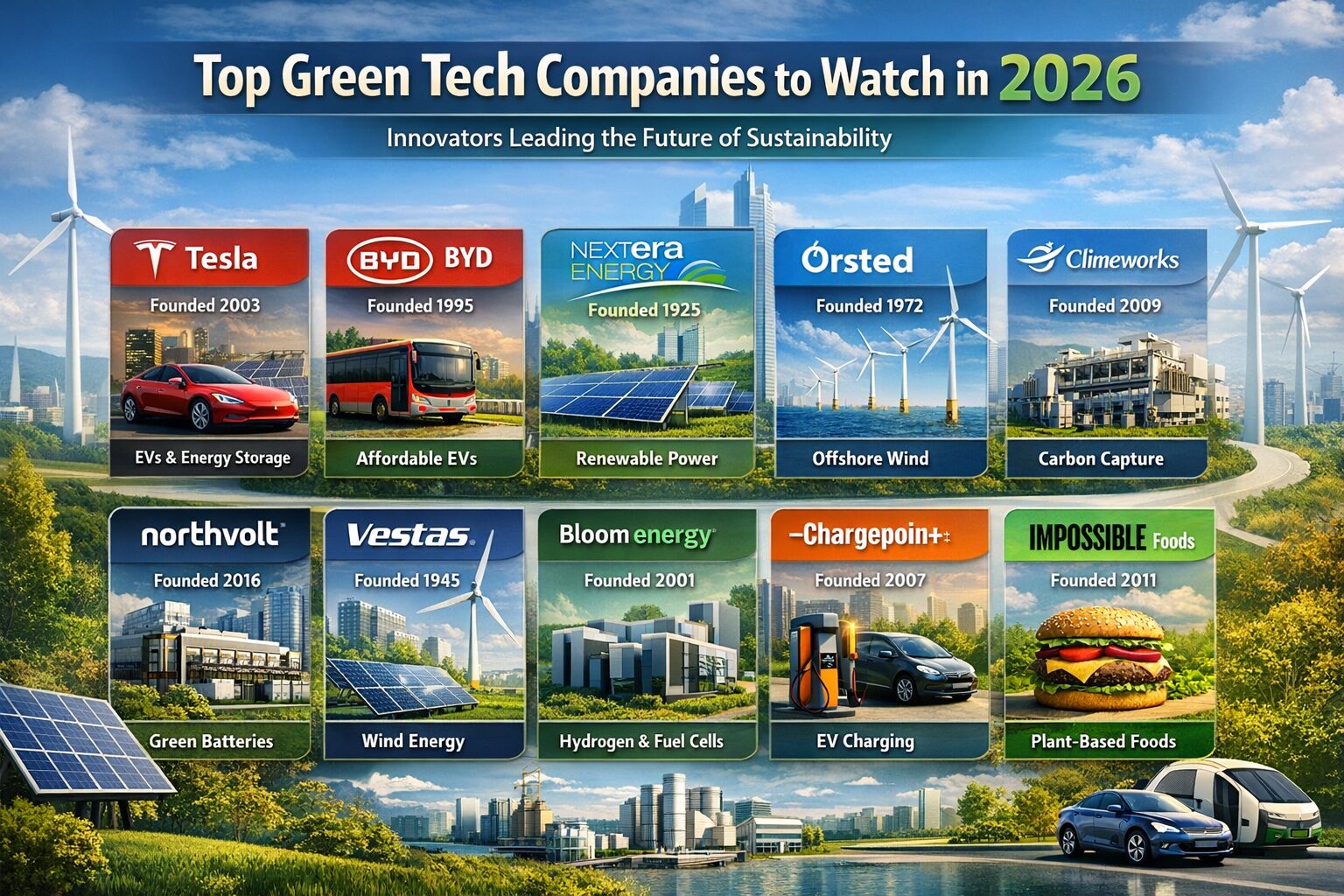
Top Green Tech Companies to Watch in 2026
Climate tech leaders driving the future of sustainability, energy, and innovation
Green technology is no longer a niche—it’s now one of the fastest-growing sectors globally. In 2026, the conversation has shifted from “why sustainability?” to “who is leading it—and how fast can they scale?”
From electric mobility and renewable energy to carbon capture and sustainable food systems, green tech companies are redefining entire industries.
If you’re exploring sustainable business trends, investment opportunities, or innovation in climate tech, this guide breaks down the companies shaping the future.
What Are Green Tech Companies?
Green tech companies develop technologies that:
- Reduce carbon emissions
- Improve energy efficiency
- Enable renewable energy adoption
- Support circular economy systems
These innovations are deeply connected to broader sustainability frameworks like ESG. If you’re new to this space, you can explore our guide on “ESG reporting standards & frameworks” to understand how businesses measure sustainability performance.
Top Green Tech Companies to Watch in 2026
1. Tesla
Founded in 2003, Tesla has evolved from an electric vehicle startup into one of the most influential clean energy companies globally. Headquartered in the U.S., it focuses on EVs, solar energy, and large-scale battery storage solutions like Megapack. Tesla’s vertically integrated approach—from battery production to AI-driven energy optimization—gives it a strong competitive advantage. Its role in accelerating EV adoption and grid-scale storage makes it central to the global energy transition.
2. BYD
Founded in 1995, BYD started as a battery manufacturer before becoming one of the largest EV producers in the world. Based in China, BYD has rapidly expanded across Asia, Europe, and Latin America with a strong focus on affordability and scalability. Its proprietary Blade Battery technology enhances safety and efficiency. BYD’s ability to produce both batteries and vehicles in-house positions it as a major player in making electric mobility accessible globally.
3. NextEra Energy
Founded in 1925, NextEra Energy is one of the largest renewable energy companies in the world. Headquartered in Florida, it operates extensive wind and solar projects across North America. The company has heavily invested in battery storage to stabilize renewable energy supply. With decades of experience in energy infrastructure, NextEra plays a critical role in transitioning traditional power grids toward cleaner, more sustainable systems.
4. Ørsted
Founded in 1972 (originally as Danish Oil and Natural Gas), Ørsted transformed itself into a global leader in renewable energy. Headquartered in Denmark, the company is best known for offshore wind farms across Europe, Asia, and the U.S. Its transition from fossil fuels to renewables is often cited as a benchmark in corporate sustainability. Ørsted continues to expand into green hydrogen and energy storage solutions.
5. Climeworks
Founded in 2009, Climeworks is a pioneer in direct air capture (DAC) technology. Based in Switzerland, the company builds facilities that remove CO₂ directly from the atmosphere and store it underground. Its projects like Orca and Mammoth are among the world’s largest carbon removal plants. As governments and corporations push for net-zero targets, Climeworks is becoming a key player in balancing unavoidable emissions.
6. Northvolt
Founded in 2016, Northvolt focuses on producing sustainable lithium-ion batteries using renewable energy. Headquartered in Sweden, the company aims to reduce the carbon footprint of battery manufacturing through recycling and closed-loop production systems. Northvolt supplies batteries to major automotive brands and is positioning itself as Europe’s leading alternative to Asian battery manufacturers, supporting regional energy independence.
7. Vestas
Founded in 1945, Vestas is one of the oldest and most established wind energy companies globally. Based in Denmark, it has installed wind turbines in over 80 countries. Vestas focuses on both onshore and offshore wind solutions and is investing in recyclable turbine technology. Its long-standing expertise and global presence make it a cornerstone of renewable energy infrastructure worldwide.
8. Bloom Energy
Founded in 2001, Bloom Energy develops solid oxide fuel cell systems that generate electricity with lower emissions. Headquartered in California, the company provides clean, reliable energy solutions for businesses and industrial applications. Bloom Energy is also investing in hydrogen-powered systems, positioning itself within the emerging hydrogen economy as industries seek alternatives to fossil fuels.
9. ChargePoint
Founded in 2007, ChargePoint operates one of the largest EV charging networks in the world. Based in the U.S., it provides charging infrastructure for residential, commercial, and fleet use. As EV adoption grows, ChargePoint plays a crucial role in enabling accessible and reliable charging. Its software-driven platform also helps businesses manage energy usage efficiently.
10. Impossible Foods
Founded in 2011, Impossible Foods is transforming the food industry with plant-based alternatives to meat. Headquartered in California, the company focuses on reducing the environmental impact of livestock farming, which contributes significantly to global emissions. Its products use less land, water, and energy compared to traditional meat production, making it a key player in sustainable food innovation.
Key Green Tech Trends in 2026
1. Electrification of Everything
Transport, buildings, and industries are shifting to electric systems.
2. Rise of Carbon Capture
Technologies like DAC are becoming critical for net-zero goals.
3. Battery Innovation Boom
Energy storage is the backbone of renewable energy.
👉 Deep dive: Renewable Energy Storage: The Future of Green Batteries
4. AI + Sustainability
AI is optimizing energy, emissions tracking, and supply chains.
5. Circular Economy Adoption
Businesses are shifting toward reuse, recycling, and waste reduction.
👉 Learn more:
What Is the Circular Economy & Why It Matters
📈 How to Evaluate Green Tech Companies
When analyzing companies, focus on:
- Real emissions reduction impact
- Scalability of technology
- ESG and regulatory alignment
- Financial sustainability
- Innovation moat
Green Tech Market Outlook (2026–2030)
- Climate tech investment moving toward trillion-dollar scale
- EV adoption accelerating globally
- Stronger ESG regulations across markets
- Rapid growth in carbon markets
Final Thoughts
Green tech in 2026 is about real impact, not just innovation.
The companies leading today are building the infrastructure for a low-carbon future—from clean energy and EVs to sustainable food systems.
If you’re building, investing, or scaling a brand in sustainability, staying aligned with these trends isn’t optional—it’s essential.
Top companies include Tesla, BYD, Ørsted, and Climeworks.
Electric vehicles, battery storage, and carbon capture are leading growth sectors.
It helps reduce emissions, improve efficiency, and transition to a sustainable economy.

Sourabh is an SEO Specialist associated with The Sustainable Brands Journal, contributing to the platform’s mission of amplifying sustainability-driven narratives. He specializes in content optimization, search strategy, and organic growth within climate, ESG, and eco-conscious industries.