
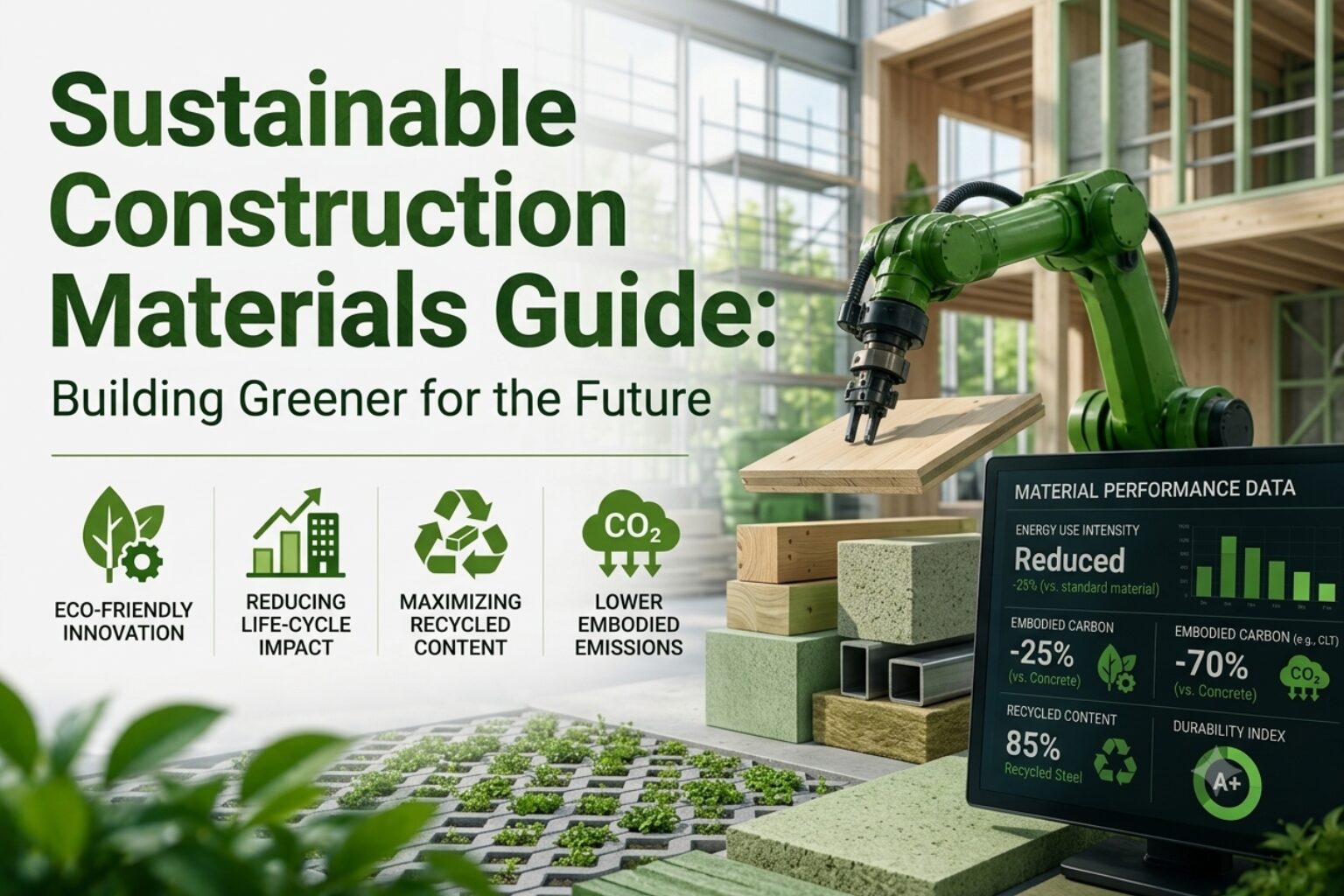
Sustainable Construction Materials Guide: Building Greener for the Future
The construction industry is responsible for nearly 40% of global energy-related carbon emissions when operational and embodied carbon are combined, making it one of the most significant sectors in the global sustainability transition. As governments strengthen climate policies and developers pursue net-zero goals, the materials used to construct buildings have become just as important as how efficiently those buildings operate.
This shift has fueled rapid growth in the sustainable construction materials market. According to recent industry estimates, the global sustainable construction materials market grew to approximately USD 359.4 billion in 2026 and is expected to continue expanding at a double-digit growth rate throughout the next decade, driven by stricter environmental regulations, green building certifications, and growing demand for low-carbon infrastructure.
From low-carbon concrete and engineered timber to recycled steel and bio-based insulation, sustainable construction materials are helping reduce emissions, conserve natural resources, and improve the long-term performance of buildings.
What Are Sustainable Construction Materials?
Sustainable construction materials are building materials designed to minimize environmental impact throughout their entire life cycle—from sourcing and manufacturing to transportation, installation, use, and eventual recycling or disposal.
Unlike conventional materials that often require energy-intensive production, sustainable alternatives prioritize:
- Lower embodied carbon
- Renewable or recycled resources
- Reduced waste generation
- Longer service life
- Improved energy efficiency
- Better indoor air quality
- Circular economy principles
Rather than focusing solely on environmental benefits, these materials also improve durability, operational efficiency, and lifecycle costs.
Why Sustainable Construction Materials Matter
The construction sector consumes enormous quantities of raw materials every year. Traditional materials such as cement, steel, and bricks require significant energy during production and contribute heavily to greenhouse gas emissions.
Sustainable materials help address these challenges by:
- Lowering embodied carbon
- Reducing landfill waste
- Conserving natural resources
- Improving building energy efficiency
- Supporting green building certifications
- Increasing resilience against climate change
- Reducing long-term maintenance costs
For developers, these benefits translate into lower operational costs, stronger ESG performance, and higher property values.
Top Sustainable Construction Materials in 2026
1. Low-Carbon Concrete
Concrete remains the world’s most widely used construction material, but traditional cement production generates significant carbon emissions.
New low-carbon concrete solutions use supplementary cementitious materials such as fly ash, slag, calcined clay, and carbon-capture technologies to reduce embodied carbon while maintaining structural performance.
Benefits include:
- Lower CO₂ emissions
- Longer durability
- Reduced cement consumption
- Improved lifecycle performance
Low-carbon concrete is increasingly being adopted in commercial buildings, infrastructure, and public projects worldwide.
2. Bamboo
Bamboo has emerged as one of the fastest-growing renewable construction materials. It matures in just a few years, absorbs large amounts of carbon during growth, and offers impressive strength-to-weight characteristics.
Modern engineered bamboo is now being used for:
- Structural framing
- Flooring
- Interior finishes
- Roofing systems
- Bridges and public buildings
Growing interest from architects and engineers is expanding bamboo’s role in mainstream construction, particularly in regions where it grows naturally.
3. Cross-Laminated Timber (CLT)
Engineered wood products such as Cross-Laminated Timber (CLT) offer a renewable alternative to concrete and steel for mid-rise buildings.
Advantages include:
- Carbon storage throughout the building’s lifespan
- Faster installation
- Reduced construction waste
- Excellent structural performance
- Lower embodied carbon
Mass timber construction continues to gain popularity across Europe and North America.
4. Recycled Steel
Steel is one of the world’s most recyclable building materials.
Using recycled steel significantly reduces:
- Mining activity
- Energy consumption
- Manufacturing emissions
- Raw material extraction
Because steel can be recycled repeatedly without losing strength, it plays a major role in circular construction practices.
5. Reclaimed Wood
Rather than harvesting new timber, reclaimed wood gives existing materials a second life.
It is commonly used for:
- Flooring
- Wall cladding
- Structural beams
- Furniture
- Decorative finishes
Besides reducing waste, reclaimed wood preserves natural resources while adding unique character to buildings.
6. Hempcrete
Hempcrete combines hemp fibers with lime-based binders to create lightweight, breathable wall systems.
Although it isn’t typically load-bearing, hempcrete offers several sustainability advantages:
- Excellent thermal insulation
- Carbon storage during growth
- Moisture regulation
- Natural fire resistance
- Reduced operational energy use
It is becoming increasingly popular in residential and low-rise construction.
7. Recycled Plastic Building Materials
Plastic waste is increasingly being transformed into:
- Composite decking
- Roofing tiles
- Insulation panels
- Modular wall systems
- Pavement blocks
These products divert plastic from landfills while reducing demand for virgin materials.
8. Cork
Harvested without cutting down trees, cork is a renewable material widely used for:
- Acoustic insulation
- Thermal insulation
- Flooring
- Interior wall panels
Its natural elasticity, durability, and moisture resistance make it suitable for both residential and commercial buildings.
9. Cellulose and Natural Fiber Insulation
Instead of petroleum-based insulation, builders are increasingly choosing:
- Recycled cellulose
- Sheep’s wool
- Hemp fiber
- Wood fiber
- Cotton insulation
These materials improve indoor air quality while reducing embodied carbon.
10. Mycelium-Based Building Materials
One of the newest innovations in sustainable construction is mycelium—the root structure of fungi.
Mycelium panels are biodegradable, lightweight, and produced using agricultural waste. They are increasingly used for insulation, acoustic panels, and interior applications, offering a promising low-carbon alternative to conventional materials.
Sustainable Construction Materials Comparison
| Material | Renewable | Recyclable | Carbon Impact | Common Uses |
|---|---|---|---|---|
| Bamboo | ✔ | ✔ | Very Low | Structural systems, flooring |
| Low-carbon concrete | Partial | Partial | Lower than conventional concrete | Foundations, buildings |
| Cross-Laminated Timber | ✔ | ✔ | Carbon storing | Mid-rise buildings |
| Recycled Steel | No | ✔ | Lower embodied carbon | Structural frames |
| Hempcrete | ✔ | Partial | Carbon negative potential | Wall systems |
| Cork | ✔ | ✔ | Low | Insulation, flooring |
| Reclaimed Wood | ✔ | ✔ | Very Low | Interior and structural applications |
| Mycelium Panels | ✔ | ✔ | Very Low | Insulation and interior panels |
Challenges Slowing Adoption
Despite growing momentum, sustainable construction materials still face several barriers:
- Higher upfront costs for some products
- Limited regional availability
- Conservative building practices
- Lack of awareness among contractors
- Building code and certification requirements
- Supply chain constraints
However, falling production costs, improved manufacturing technologies, and supportive government policies are accelerating adoption across both residential and commercial construction.
The Future of Sustainable Construction
The next generation of buildings will combine sustainable materials with digital technologies such as Building Information Modeling (BIM), AI-driven design optimization, prefabrication, and lifecycle carbon assessment.
Modular construction, low-carbon cement, engineered timber, recycled composites, and bio-based materials are expected to become standard components of green buildings as the industry moves toward net-zero development. Recent projects also show increasing adoption of recycled wood, fly ash bricks, bamboo composites, and modular prefabrication to reduce waste and improve efficiency.
Conclusion
Sustainable construction materials are no longer niche alternatives—they are becoming the foundation of modern building practices. From renewable resources like bamboo and hempcrete to recycled steel, low-carbon concrete, and innovative mycelium panels, these materials help reduce emissions, conserve resources, and improve long-term building performance.
As governments, developers, and investors prioritize decarbonization and circular economy principles, choosing the right materials will be essential for creating resilient, energy-efficient, and future-ready buildings.
For architects, builders, and property owners alike, sustainable construction is no longer just about reducing environmental impact—it’s about delivering healthier, more durable, and economically viable spaces for generations to come.

Sourabh is an SEO Specialist associated with The Sustainable Brands Journal, contributing to the platform’s mission of amplifying sustainability-driven narratives. He specializes in content optimization, search strategy, and organic growth within climate, ESG, and eco-conscious industries.