
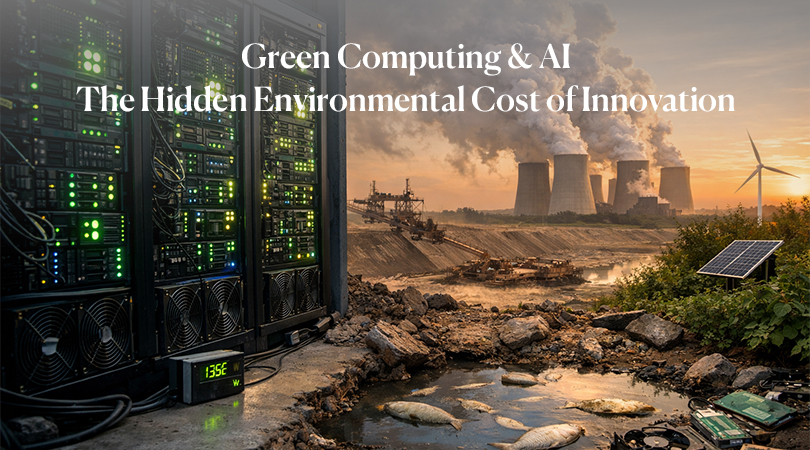
Green Computing & AI: The Hidden Environmental Cost of Innovation
Artificial Intelligence is transforming the world, from healthcare to finance to climate modeling itself. But behind this rapid innovation lies a lesser-discussed reality: AI and computing come with a growing environmental cost.
As we build smarter systems, the question we must ask is, at what ecological price?
The Environmental Cost of AI: Why Green Computing Matters in 2026
The Energy Behind Intelligence
Modern AI systems rely on vast computational power. Training large-scale models can consume thousands of megawatt-hours (MWh) of electricity, often equivalent to the annual energy use of hundreds of households.
Data centers, the backbone of AI, already account for around 1–1.5% of global electricity consumption, and this number is rising as AI adoption accelerates.
Every search, every model run, every automated process draws energy, making digital activity far from “invisible” in environmental terms.
Carbon Footprint of AI Models
Training a single advanced AI model can generate significant carbon emissions, especially when powered by fossil-fuel-based grids.
Key contributors include:
- High-performance GPUs and servers
- Continuous model training and retraining
- Large-scale data storage
As AI becomes more embedded in daily life, its cumulative carbon footprint is growing, quietly but rapidly.
The Data Center Dilemma
Data centers are expanding globally to meet AI demand. While they enable innovation, they also:
- Consume massive amounts of electricity
- Require extensive cooling systems
- Put pressure on local water resources
Cooling alone can use millions of liters of water annually, raising concerns in water-stressed regions.
This creates a paradox: The digital world feels weightless—but its infrastructure is resource-intensive.
E-Waste: The Overlooked Impact
Beyond energy, hardware turnover adds another layer of environmental cost.
Frequent upgrades in:
- Servers
- GPUs
- Storage systems
lead to increasing electronic waste (e-waste), one of the fastest-growing waste streams globally.
Much of this waste is difficult to recycle and often ends up in landfills, releasing toxic materials into the environment.
The Rise of Green Computing
The good news? The industry is beginning to respond.
Green computing focuses on:
- Energy-efficient algorithms
- Renewable-powered data centers
- Optimized model training (doing more with less compute)
Major tech players are investing in carbon-neutral or carbon-negative goals, while startups are building solutions that reduce AI’s environmental footprint.
Smarter AI, Lower Impact
A key shift in 2026 is moving from “bigger models” to “better models.”
This includes:
- Model compression and efficiency techniques
- Edge computing to reduce data transfer
- Selective training instead of continuous retraining
The goal is clear: maximize intelligence while minimizing resource use.
Why This Conversation Matters
AI has the potential to solve climate challenges—but if left unchecked, it can also contribute to them.
Balancing innovation with sustainability requires:
- Transparent reporting of AI energy use
- Responsible infrastructure planning
- Conscious consumption of digital services
Because sustainability isn’t just about physical industries anymore, it’s deeply tied to our digital future.
Conclusion
Green computing is no longer optional, it’s essential.
As AI continues to shape the world, we must ensure that progress does not come at the cost of the planet.
The future of innovation must be both intelligent and sustainable.
Because true advancement isn’t just about what we build, It’s about how to responsibly build it.

Sourabh is an SEO Specialist associated with The Sustainable Brands Journal, contributing to the platform’s mission of amplifying sustainability-driven narratives. He specializes in content optimization, search strategy, and organic growth within climate, ESG, and eco-conscious industries.