
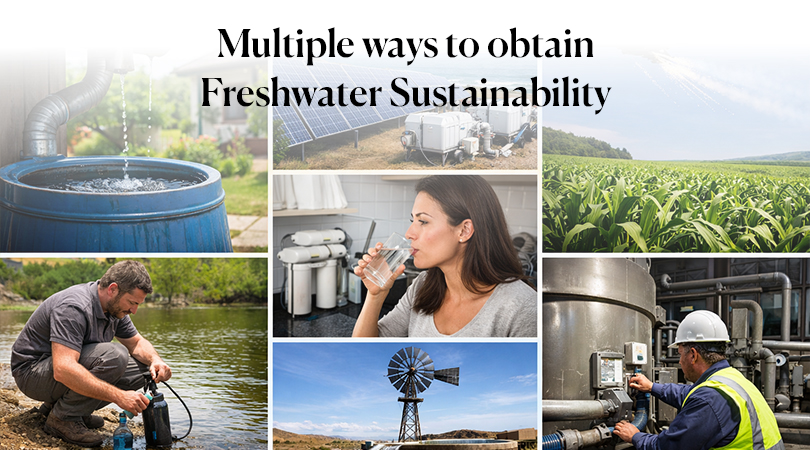
Multiple Ways to Obtain Freshwater Sustainably
Freshwater is one of our planet’s most critical—and increasingly scarce—resources. While Earth is covered in water, only about 2.5% is freshwater, and less than 1% is easily accessible for human use.
With rising populations, climate change, urbanization, and water scarcity, the need for sustainable freshwater solutions has never been more urgent.
The good news? Innovation and traditional wisdom together offer multiple ways to secure water without depleting ecosystems—through water conservation, circular water economy, and sustainable water management practices.
The Future of Sustainable Freshwater: Innovation, Policy, and Global Impact
1. Rainwater Harvesting
One of the oldest and most effective methods.
By collecting and storing rainwater from rooftops or open surfaces, communities can:
- Reduce dependence on groundwater resources
- Support aquifer recharge
- Ensure water availability during dry periods
In urban areas, rainwater harvesting systems can significantly cut household water demand and improve urban water sustainability.
2. Desalination (With Renewable Energy)
Desalination converts seawater into freshwater—but traditionally, it has been energy-intensive.
Now, when powered by renewable energy (solar and wind) and advanced reverse osmosis technology, it becomes a more viable sustainable water solution.
Countries in water-scarce regions are increasingly adopting energy-efficient desalination plants to reduce environmental impact and support long-term water security.
3. Wastewater Recycling & Reuse
Used water doesn’t have to go to waste.
Modern wastewater treatment systems can purify water for:
- Agricultural irrigation
- Industrial processes
- Even potable water reuse (advanced treatment systems)
Recycling water helps reduce pressure on freshwater sources and supports a circular water economy and water reuse systems.
4. Groundwater Recharge
Over-extraction of groundwater is a global issue.
Artificial recharge methods—such as:
- Percolation tanks
- Recharge wells
- Check dams
help restore depleted aquifers by enabling managed aquifer recharge (MAR) and improving groundwater sustainability.
This ensures long-term water availability for agriculture and communities.
5. Fog & Dew Harvesting
In arid and coastal regions, innovative systems are capturing water from the air.
Atmospheric water harvesting technologies, such as fog nets and condensation systems, can:
- Collect moisture droplets
- Provide clean drinking water in water-scarce areas
Though small-scale, these solutions are life-changing and support climate-resilient water solutions.
6. Sustainable Agriculture Practices
Agriculture uses nearly 70% of global freshwater resources, making it central to solving water scarcity.
Shifting to:
- Drip irrigation systems
- Precision agriculture technologies
- Drought-resistant crops
can drastically reduce water consumption while maintaining productivity. This is one of the most impactful ways to improve water-use efficiency and sustainable irrigation practices at scale.
7. Protecting Natural Ecosystems
Forests, wetlands, and rivers naturally regulate water cycles.
Protecting and restoring these ecosystems helps:
- Maintain water quality management
- Prevent floods and droughts
- Support biodiversity and ecosystem sustainability
Nature itself plays a critical role in sustainable water resource management.
8. Smart Water Management & Technology
Technology is transforming how we manage water.
Innovations include:
- IoT-based water monitoring systems
- Leak detection technologies
- AI-driven water management systems
These tools help reduce non-revenue water loss, improve efficiency, and enable data-driven water distribution systems across cities and industries.
Why It Matters Now
Over 2 billion people globally lack access to safely managed drinking water, and global demand is expected to exceed supply by 40% by 2030.
Without sustainable solutions, global water scarcity could become one of the biggest environmental and economic crises.
However, with the right mix of water conservation strategies, green infrastructure, and sustainable development policies, we can build systems that ensure water for all—without exhausting the planet.
Conclusion
Freshwater sustainability is not about a single solution—it’s about multiple, interconnected approaches.
From rainwater harvesting to wastewater recycling, every method contributes to a more resilient water system.
Because water is not just a resource—it is the foundation of life, ecosystems, and sustainable development.
Protecting it today means sustaining tomorrow.
The most sustainable methods include rainwater harvesting, wastewater recycling, groundwater recharge, and desalination using renewable energy.
Wastewater reuse systems reduce dependency on freshwater sources and promote a circular water economy, making water use more efficient.
Yes, especially when combined with renewable energy and energy-efficient technologies, making it a viable long-term water solution.
Managed aquifer recharge is the process of intentionally storing water underground to replenish depleted groundwater resources.
With rising water demand and climate change impacts, conservation ensures long-term water security and environmental sustainability.

Sourabh is an SEO Specialist associated with The Sustainable Brands Journal, contributing to the platform’s mission of amplifying sustainability-driven narratives. He specializes in content optimization, search strategy, and organic growth within climate, ESG, and eco-conscious industries.